
Flight Delay Insurance Explained: Don’t Get Fooled by Small Print.
I’ve stood in enough departure lounges to know the exact moment a delay becomes a problem. It’s not when the board flips from “On Time” to “Delayed” — it’s the second flip after that, when the new time is also wrong. That’s when people start Googling “flight delay insurance” on their phones with 4% battery, half hoping there’s a magic policy that pays out for stress, missed dinners, and a taxi that’s now going to cost double.
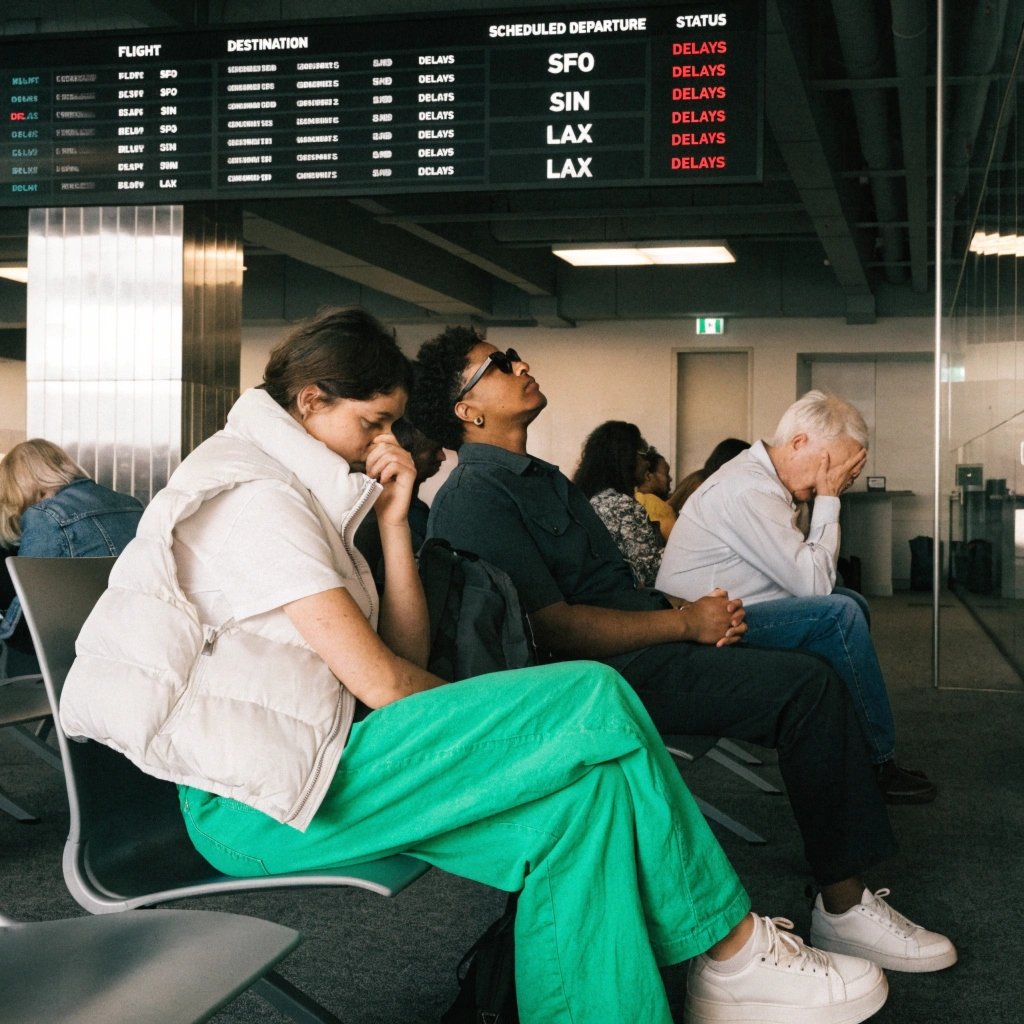
There isn’t a policy for stress. But there is real money on the table if you know where to look — and just as much confusion about who actually pays it: the airline, or your insurer. Let’s sort that out properly, in plain English, before your next trip.
What Is Flight Delay Insurance, Really?
Flight delay insurance is a section within a travel insurance policy (it’s very rarely sold on its own) that pays you a fixed amount if your flight is delayed past a set number of hours — usually somewhere between 2 and 12, depending on the insurer. It’s meant to cover the annoying extras: a meal at the airport, a night in a hotel if you miss a connection, that sort of thing.
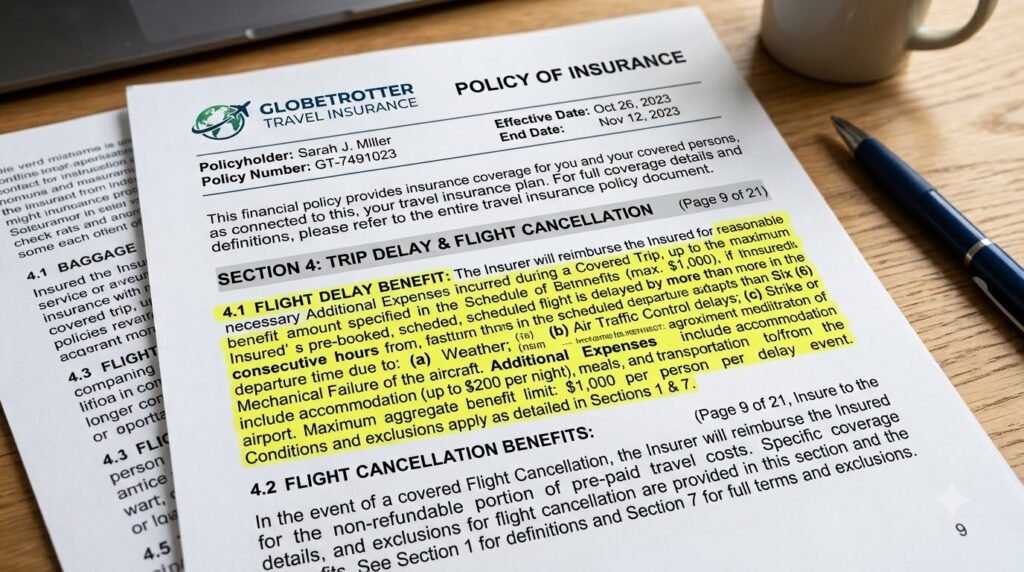
The important bit: this payout has nothing to do with whether the airline was at fault. Weather, strikes, a bird strike on the runway, a technical fault — most delay cover pays out regardless of cause, as long as you hit the time threshold. That’s the whole point of buying it.
Flight Delay Compensation vs Travel Insurance — Stop Mixing These Up
This is the single most Googled confusion on this topic, and fair enough, because the two systems overlap in the worst way. One is a legal right. The other is a product you had to buy.
| Flight Delay Compensation | Travel Insurance (Delay Cover) | |
|---|---|---|
| What it is | A legal claim against the airline under UK261 rules | A benefit you paid for as part of your policy |
| Who pays | The airline | Your insurer |
| Depends on cause? | Yes — airline must be at fault (not “extraordinary circumstances” like severe weather) | Usually no — pays out regardless of cause once the time threshold is hit |
| Typical trigger | 3+ hours delay on arrival | 2–12 hours, set by your policy |
| Cost to you | Free to claim | Only if you bought a policy that includes it |
| Best for | Delays caused by the airline (crew shortages, tech faults) | Delays caused by weather, strikes, air traffic control |
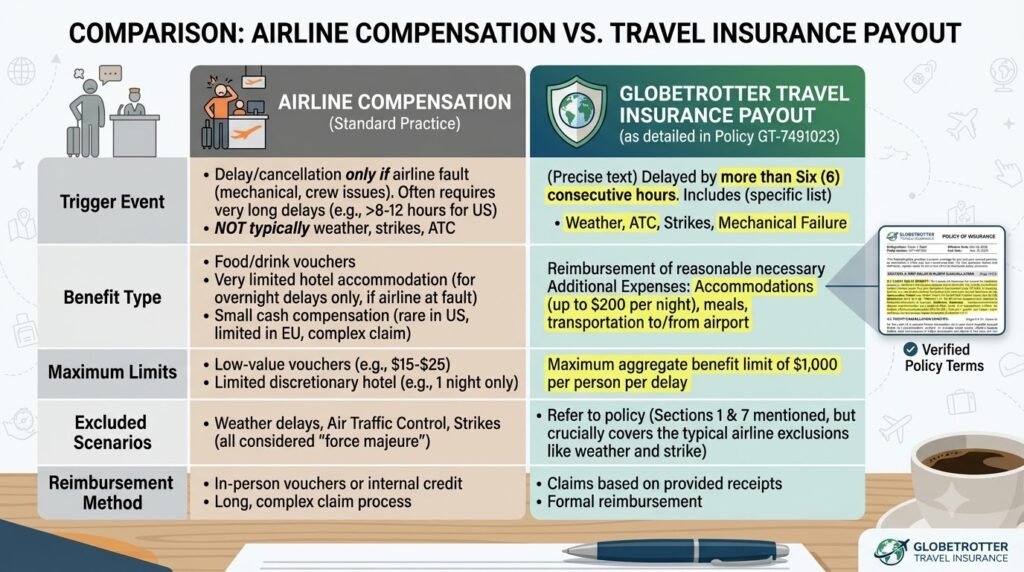
Here’s the bit that trips people up: you can often claim both. The airline compensation and your insurance payout aren’t mutually exclusive, because they’re compensating for different things — one’s a legal remedy, the other’s a benefit you’re entitled to under your contract. Worth checking your policy wording, but don’t assume claiming one rules out the other.
| Delayed because of the airline?
If it looks like the airline’s fault — a crew issue, a mechanical fault, an overbooking mess — you may be owed up to £520 under UK compensation rules. |
Frequently Asked Questions
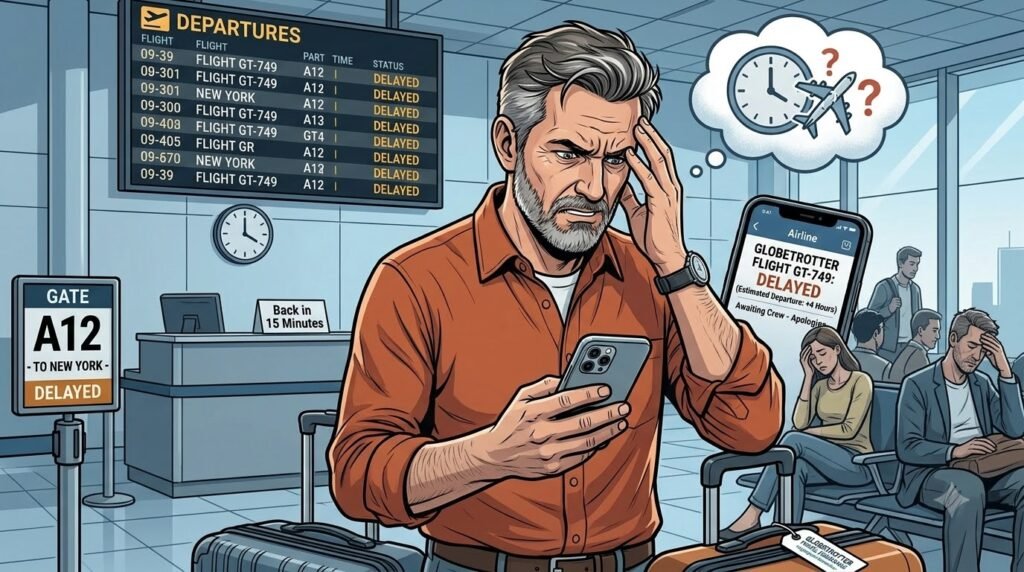
Is flight delay covered by insurance?
Only if your policy specifically includes delay cover — it’s not automatic on every travel insurance product. Cheaper, stripped-back policies sometimes leave it out entirely, so it’s worth checking the policy schedule (not just the marketing page) before you buy. Look for a line that names a delay benefit, a time threshold, and a payout amount.
Is a flight delay of 2 hours compensation?
Under UK261 airline compensation rules, 2 hours generally isn’t enough to trigger a cash payout — the airline’s duty at that point is usually limited to food, drink, and a couple of phone calls, not compensation. Compensation typically kicks in at 3+ hours delay on arrival, and the amount depends on flight distance. However, some travel insurance delay benefits do trigger at 2 hours, since that threshold is set by the insurer, not the airline rulebook. So a 2-hour delay can be a “no” from the airline and a “yes” from your insurer, on the same day, for the same flight.
Can I claim insurance if my flight is delayed?
Yes, provided three things line up: your policy includes delay cover, the delay meets or exceeds the stated threshold, and you can show proof — a letter from the airline, a screenshot of the delay notice, boarding pass, and receipts for anything you’re claiming back. Insurers are fairly strict about paperwork, so keep everything from the moment the delay is announced.
Can I claim for a 2-hour flight delay?
You can, but only through travel insurance with a 2-hour (or lower) trigger — and only if you actually have that cover. It’s one of the details worth comparing before you buy, because plenty of standard policies set the bar at 4, 6, or even 12 hours instead.
Travel Delay Cover: £ Per Hour, Explained
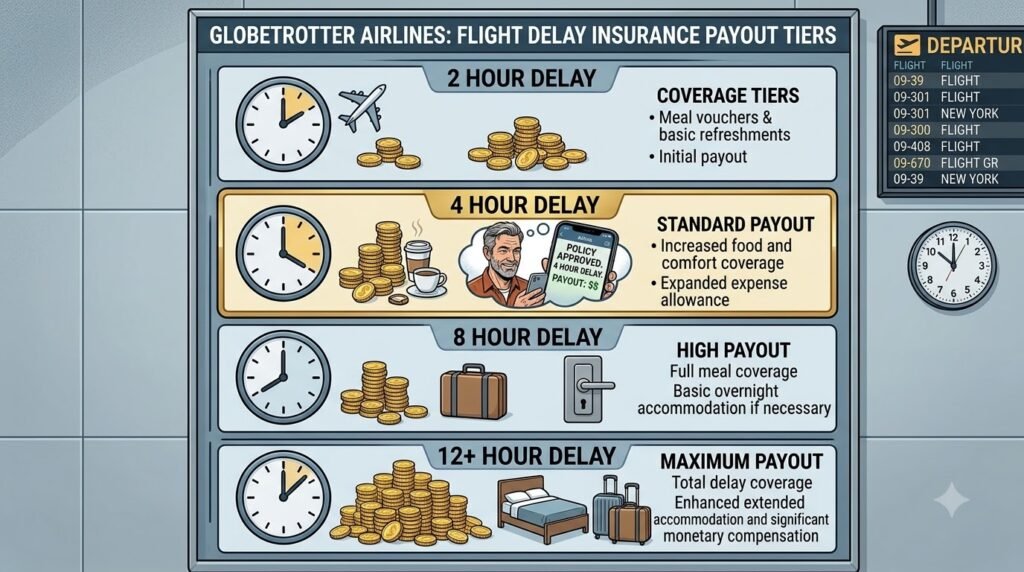
Delay cover isn’t usually paid “per hour” in a strict sense — most UK insurers pay a fixed lump sum once you cross the threshold, then sometimes a smaller top-up for every additional block of hours after that. Here’s roughly how it tends to break down:
| Delay length | Typical payout structure | What it’s meant to cover |
|---|---|---|
| 2–4 hours | £20–£30 initial payout | Meals, snacks, drinks |
| 4–8 hours | £30–£60 total | Meals plus incidentals |
| 8–12 hours | £60–£100+, sometimes with an overnight benefit | Meals, hotel, transport |
| 12 hours+ / overnight | Separate “missed departure” or abandonment benefit may apply | Hotel, rebooking costs |
Figures vary a lot by insurer and policy tier, so treat this as a rough shape rather than a quote. Always check the actual policy document — the number that matters is the one in your schedule, not the average.
Cheapest Travel Insurance With Flight Delay Cover
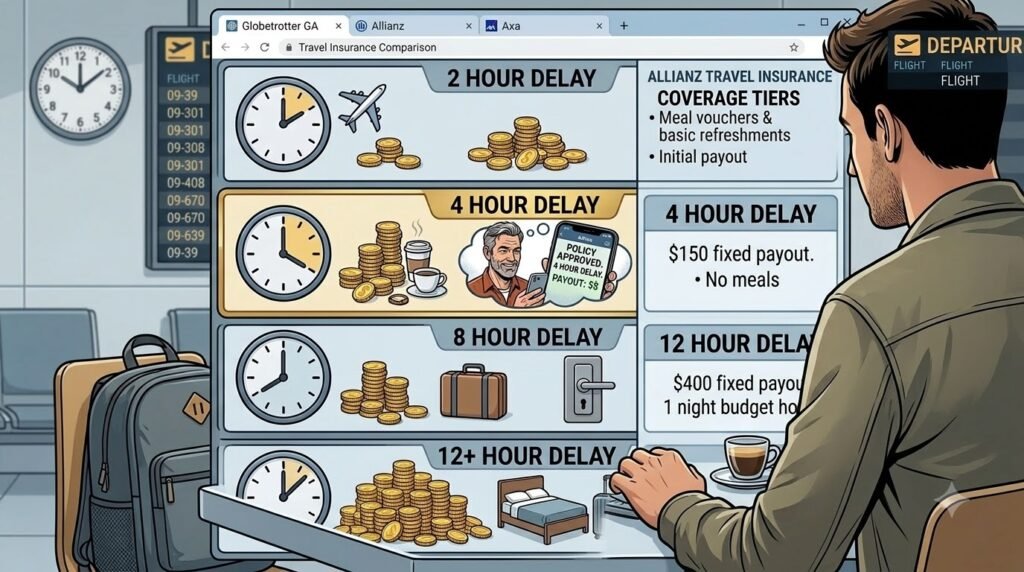
You don’t need the most expensive policy to get decent delay cover — you need one where delay cover isn’t an afterthought. A few things worth comparing side by side: the delay threshold (lower is better), the payout amount, whether it stacks with missed-connection cover, and whether weather-related delays are explicitly included rather than quietly excluded.
| Comparing policies before you buy?
VisitorsCoverage lets you compare delay thresholds and payouts side by side in a few minutes, which beats reading five separate policy wordings on your phone. |
| Frequent flyer, multiple trips a year?
If you’re travelling more than once or twice a year, an annual multi-trip policy from EKTA often works out cheaper than buying single-trip cover every time — and it usually includes delay benefits as standard. |
Weather Delay Travel Insurance UK — The Bit Nobody Reads Until It’s Too Late
Here’s an uncomfortable truth: airline compensation almost never covers weather delays. Storms, fog, snow at the destination airport — these count as “extraordinary circumstances” under UK261, which basically means the airline gets to shrug and say it wasn’t their fault. Legally, they’re often right.
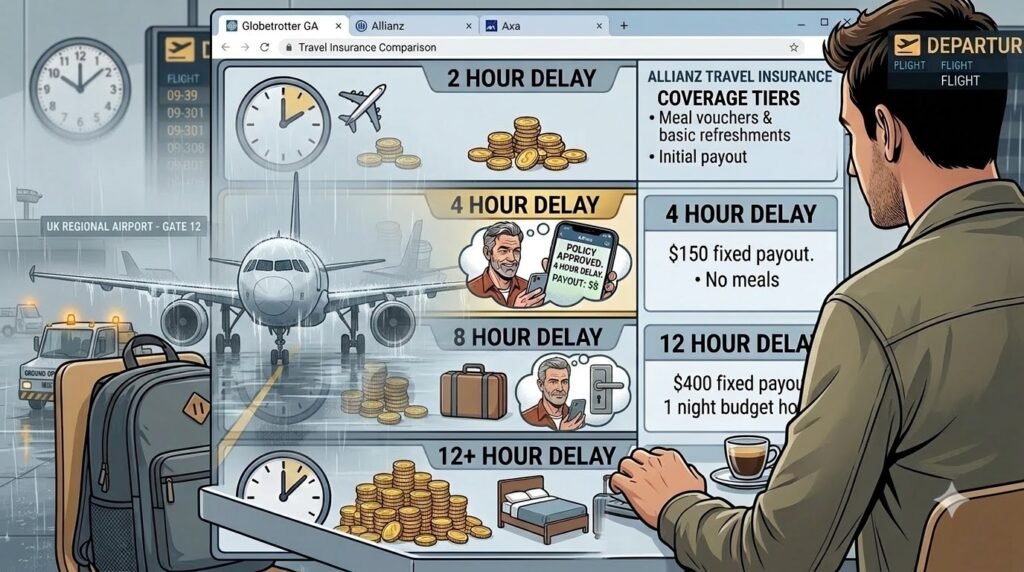
This is exactly where travel insurance earns its keep. Most delay benefits don’t care why you were delayed — weather counts the same as a technical fault, as long as you crossed the time threshold. If you’re travelling in winter, or to somewhere with a habit of fog and gales (looking at you, British weather), it’s worth double-checking that your policy explicitly names weather as a covered delay cause, rather than assuming it.
The “My Flight’s Delayed, Now What” Toolkit
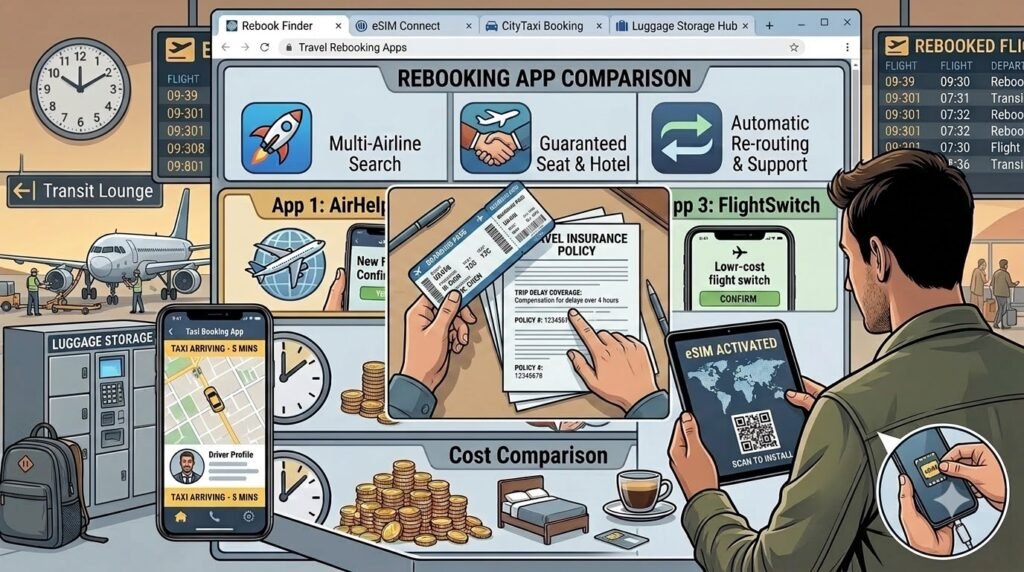
Insurance sorts out the money eventually. In the moment, you’ve usually got a few hours to fill and some logistics to rearrange. A few things that genuinely help:
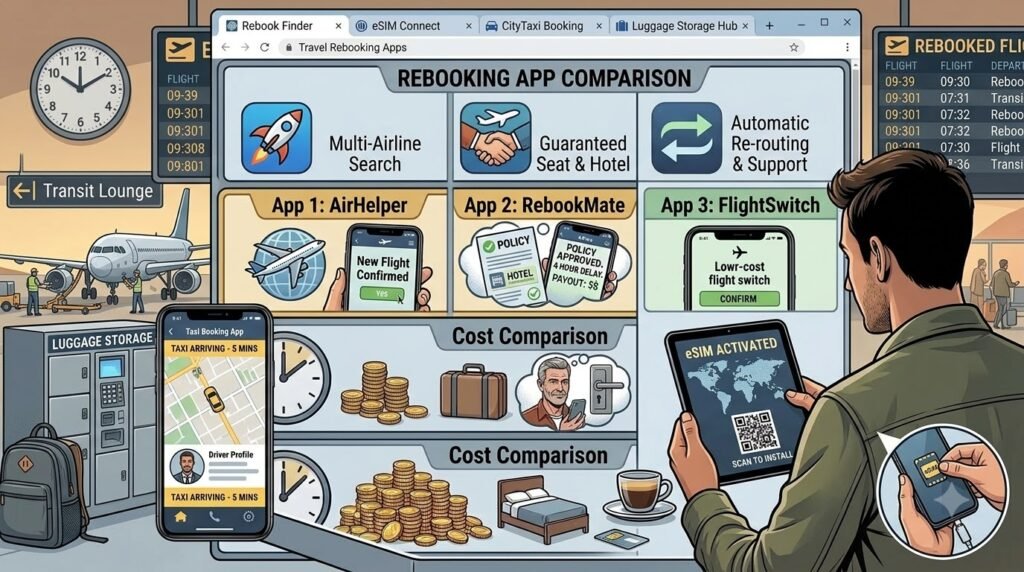
Rebooking or finding a cheaper alternative
- Kiwi.com and Aviasales are handy for scanning alternative routes fast if you need a new flight.
- Trip.com and Economybookings.com are worth a look for last-minute flight or hotel rebooking if you’re stuck overnight.
Staying connected to sort it all out
- A local eSIM from Airalo, Yesim, or Drimsim means you’re not relying on patchy airport wifi to rebook, message home, or chase your insurer.
Getting where you’re actually going
- If a delay wrecks your original transfer, Welcome Pickups, Kiwitaxi, or GetTransfer.com let you rebook a pickup for your new arrival time instead of scrambling for a taxi at 2am.
Killing the wait productively
- Stash your bags with Radical Storage if you’re stuck near a city for hours and want to explore instead of sitting at the gate, then check Tiqets or WeGoTrip for something to actually do with the time.
None of these fix the delay itself. But they’re the difference between a bad afternoon and a genuinely wasted day — and a couple of them (the transfers especially) can save you real money over booking blind at the airport.
The Bottom Line
Flight delays are annoying by design — nobody plans for them, which is exactly why the money side is worth sorting before you fly, not during. Two separate systems can pay you: airline compensation if they’re at fault, and travel insurance delay cover regardless of cause, as long as you’ve actually bought that benefit and it’s triggered by the right time threshold.
Affiliate disclosure: Some links in this article are affiliate links. If you book or buy through them, we may earn a small commission at no extra cost to you. We only recommend things we’d genuinely use ourselves.
Before your next trip: check your policy schedule for a named delay benefit and threshold, keep every document from the moment a delay is announced, and remember that a weather delay is where insurance — not the airline — is usually your best shot at getting anything back. Compare a couple of policies now, while you’re not stressed and standing in a departure lounge with 4% battery.